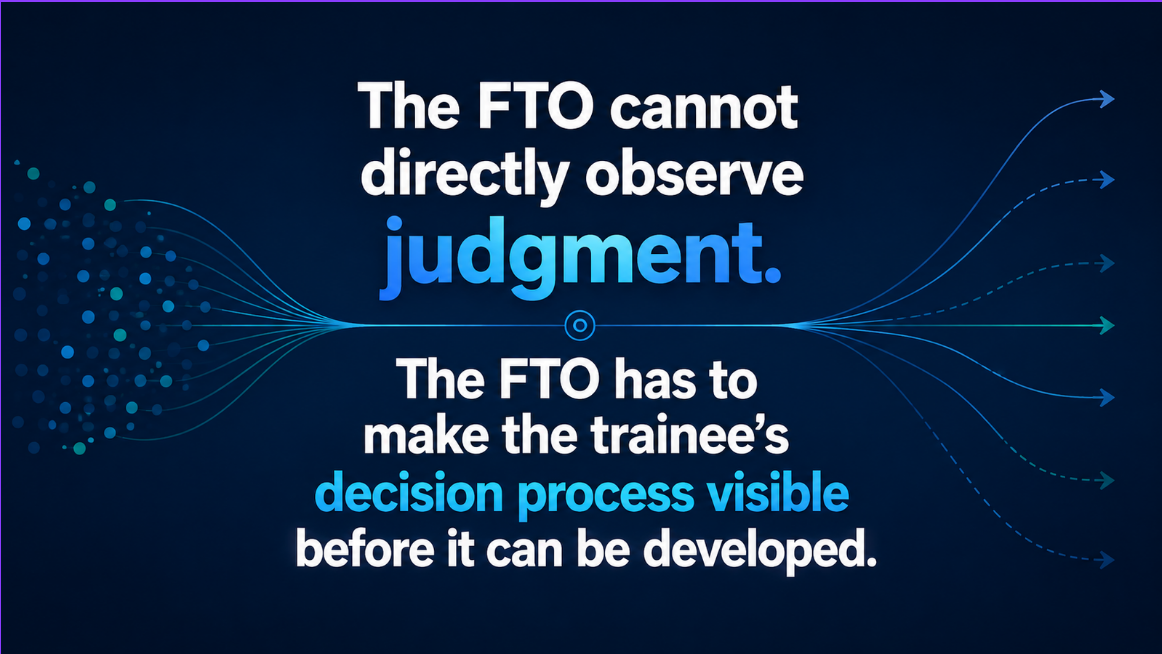
I failed FTO.
Even now, writing those words makes me uncomfortable. I entered field training accustomed to succeeding. I had recently graduated at the top of my academy class, earned honors, and received a significant leadership award. I had worked hard to prepare for my continued career in law enforcement, and I entered the field training program believing I had demonstrated both the ability and determination to succeed.
For a while, that seemed true. My early evaluations were strong. Then, as the expectations for independent performance increased, my performance began to decline. Tasks that seemed straightforward while watching someone else perform them became much harder when I had to recognize, initiate, organize, and complete them myself.
Eventually, I reached an outcome I had not anticipated.
I failed.
My first instinct was to figure out what had gone wrong. That reflection was uncomfortable because the answer could not simply be that the training program had failed me. I made mistakes. I missed things I should have recognized. I needed prompting when I was expected to be more independent. I did not put all the pieces together quickly enough.
Those deficiencies belonged to me.
But accepting responsibility for failure does not eliminate the value of examining it. Failure should make us curious. If someone performs strongly in one educational environment, performs well during the earlier stages of another, and then struggles as independence, complexity, and stress increase, it’s worth asking why—not to excuse the outcome, but to understand what it may teach us about training.
My failure forced me to consider a question much larger than my own performance: Are our field training programs designed primarily to evaluate developing officers, or to develop them?
They must do both. How well we balance those responsibilities matters.
The Standard Is Not the Problem
Any discussion about changing police training can quickly sound like an argument for making it easier. That is not the goal here.
Police officers exercise extraordinary authority. Their decisions affect liberty, constitutional rights, personal safety, property, and, in extreme circumstances, life itself. No agency should release an officer to independent duty simply because that person worked hard, wants the job badly, or struggled with the training process.
Competence is not optional. The standard has to remain high.
Training methods, however, should remain open to examination.
Maintaining a professional standard does not require preserving every method historically used to reach it. The better question is whether our training practices effectively develop the knowledge, judgment, skills, and independent decision-making we ultimately expect officers to demonstrate.
That question matters as the people entering policing change. Today’s recruits come from different generations, educational backgrounds, professions, cultures, and life experiences. Some arrive already familiar with law enforcement or military culture. Others do not. They also differ in how they process information, respond to stress, receive feedback, and translate conceptual knowledge into practical performance.
Recognizing those differences does not lower the standard. Standardizing the outcome does not require standardizing every path used to reach it.
One thing I learned about myself during field training is how heavily I depend on practical application. I can read a procedure, listen to someone explain it, watch someone perform it, and often explain what should happen. But there are things I do not fully integrate until I physically perform them myself.
Sometimes I need to perform a task more than once. Sometimes—and this is the uncomfortable part—I need to get it wrong, understand why I got it wrong, and then do it again.
I have joked for years that this is a terrible way to learn in law enforcement. During field training, I learned how true that can be.
Police work does not happen in a controlled classroom. Real people are involved. Constitutional rights are involved. Officer safety is involved. An FTO cannot allow a trainee to make every possible mistake simply for the educational value of experiencing failure.
Still, field training provides substantial opportunity for supervised experiential learning. My difficulties became more pronounced as I moved from observing and assisting to independently managing increasingly complex tasks. Watching an investigation was not the same as conducting one. Knowing the individual components of police work did not automatically mean I could retrieve, prioritize, and integrate them while simultaneously managing a dynamic environment.
A deficiency is still a deficiency. But from a training perspective, there is an important difference between not knowing what to do and knowing what to do but not yet being able to perform it consistently under operational stress.
Knowing which problem exists should influence how we train it.
That brings me to one of the simplest—and perhaps most valuable—questions an FTO can ask after a trainee gets something wrong:
“Walk me through what you were thinking.”
Some areas of law enforcement training still reflect an older philosophy: the instructor speaks, the trainee listens, and correction is accepted without discussion. Attempts to explain a decision can be interpreted as arguing, making excuses, or refusing to accept responsibility.
An important principle underlies that tradition. Police officers must be able to receive criticism. A trainee who has an explanation for every deficiency but ownership of none will be difficult to train and, eventually, difficult to work with.
Police work requires us to function alongside other officers, answer to supervisors and command staff, and interact professionally with a public that will sometimes question our decisions. If every correction becomes an argument and every mistake requires an excuse, the problem eventually becomes larger than the original mistake. Being a good officer requires enough humility to listen, own what is yours, correct it, and move forward.
But explanation and justification are not the same thing.
Simply being told the correct answer did very little to help me understand why I had reached the wrong one. There are relatively few situations in police work that follow a two-step process as simple as:
“See bad. Make lawful correction. Bad no bad now.” – Read that in your best caveman voice.
Police decision-making is rarely linear. It is more like a complicated flowchart—sprinkled occasionally with the same tense dynamic as Chutes and Ladders. Each fact can influence what comes next, and one material detail can change the legal authority available, an officer’s options, or what response is reasonable under the circumstances.
So when I reached the wrong conclusion, I needed to know where my reasoning departed from the correct path. What had I recognized correctly? What had I misunderstood or overlooked? Where had I stepped left when the reasoning required me to step right?
That is not asking for partial credit on a wrong decision. The final decision matters. It is about identifying the actual deficiency so you can correct it and test again.
The same wrong outcome can come from very different problems. A trainee may misunderstand the law, overlook a critical fact, misinterpret its significance, misunderstand previous instruction, or lose a piece of the puzzle while managing several competing demands. Those deficiencies can produce the same wrong answer without requiring the same training response.
Consider a traffic-enforcement scenario. A trainee correctly identifies a violation, understands the law and the reason for enforcement, but positions the patrol vehicle in a way that prevents the recording system from adequately capturing the violation. The outcome is flawed, but the entire thought process is not. The training need is narrower: identify the positioning problem, correct it, and determine whether the trainee recognizes and avoids it next time.
That distinction becomes especially important with repeated mistakes. Making the same mistake multiple times after receiving corrective instruction is fundamentally different from making it multiple times before anyone has identified it as a mistake.
Once feedback is given, the next repetition provides information. Did the trainee understand the correction? Could it be applied independently? Did the behavior change?
That is what gives repetition instructional value. Without correction, repetition can reinforce a bad habit just as easily as a good one.
Correct answers deserve some scrutiny too. A trainee can memorize that a particular situation produces a particular response without understanding why. That works until one material fact changes. Police training cannot prepare an officer for every call, so it has to develop something more durable than the ability to reproduce the right answer to a familiar problem.
Eventually, an officer needs to be able to articulate: These are the facts I observed. This is what I believe they mean. This is the authority I have. These are my options. This is the action I believe is reasonable, and this is why.
That officer has learned more than the answer to one call. That officer has learned how to think through the next one.
And the next one may look nothing like the last.
Measuring Performance Without Losing the Person
My experience also caused me to reconsider the role numerical scoring plays in field training.
Rating systems serve legitimate purposes. Agencies need documentation, supervisors need ways to monitor progress, and training programs need reasonably consistent standards for determining whether trainees are moving toward independent performance.
Numbers help accomplish those things.
The problem begins when we keep squeezing a score, expecting it to somehow tell us why. At some point, we are asking one number to solve an equation with half the variables missing. The number itself may be accurate. The conclusion we draw from it may not be.
And many of those missing variables cannot be recovered by adding more numbers.
A one-to-five rating can document observable performance, but it cannot fully measure comprehension. The same score could represent a first independent attempt, a single prompt, repeated intervention, poor execution despite adequate knowledge, or a significant knowledge deficit.
The number may be identical. The training problem is not.
This matters when scores are averaged, graphed, and used to demonstrate progression or regression. A declining trend line appears to tell a simple story: the trainee is getting worse.
Sometimes that is exactly what is happening.
But field training is not static. As a trainee progresses, independence, complexity, and cognitive demands increase. A lower score during a more demanding phase may still represent unacceptable performance, but the number alone cannot explain why the performance changed.
That is the danger of false precision.
Police competence includes legal knowledge, judgment, communication, situational awareness, officer safety, investigative ability, adaptability, and decision-making under stress. Reducing that interaction to an integer may be administratively necessary. Treating the integer as a complete representation of the officer being developed is something else.
Police officers are entrusted with too much authority, and their decisions carry too much consequence, for us to confuse a grade with comprehension.
Numbers should inform professional judgment, not replace it. The rest requires narrative, context, and an honest assessment of what the trainee actually understands and can independently do.
The score documents performance. Training should develop it.
Another variable in field training is uncomfortable to discuss precisely because it is difficult to quantify: personality.
Field training places two people in unusually close professional contact, often for an entire shift and under significant stress. One is learning while simultaneously being evaluated. The other teaches, supervises, corrects, and documents performance that may ultimately determine whether the trainee progresses. It is unrealistic to believe interpersonal dynamics do not affect that relationship.
Some personalities work naturally well together. Others do not. That does not necessarily mean either person is unprofessional or incapable. Communication and instructional styles differ. One trainee may process information through discussion while another responds better to direct correction. One instructor may teach through questions while another is more authoritative.
Sometimes two capable people simply do not work particularly well together.
Recognizing that should not automatically be dismissed as weakness or “FTO shopping.” Trainees cannot change instructors every time they receive criticism or an unfavorable evaluation. Learning to work with different personalities is part of being a professional, particularly in law enforcement.
But assuming every interpersonal conflict should simply be endured because the trainee “needs to adapt” ignores the unusual power dynamic of the relationship.
An FTO is not simply a coworker. The FTO helps create the environment in which the trainee performs and then evaluates that performance. Persistent tension can affect communication, willingness to ask questions, receptiveness to feedback, confidence, and ultimately performance. It can also influence how that performance is interpreted.
That does not require intentional bias. People form impressions of one another. A trainee viewed as engaged by one instructor may be perceived as argumentative by another. A question can look like curiosity to one person and resistance to another. Hesitation can be interpreted as thoughtful caution or lack of confidence.
FTOs are not immune to those influences, even as experienced professionals. Neither are trainees.
Perception becomes particularly consequential when the line between the standard and the FTO’s preference begins to blur.
Across different areas of law enforcement, I have experienced training where “this is how I would do it” began to sound a lot like “this is how it must be done.”
Those are not always the same thing.
Police work often allows more than one lawful, safe, reasonable, and policy-compliant response to the same circumstances. Experience gives an FTO tremendous knowledge worth passing on. But an individual FTO’s preferred method should not automatically become the only acceptable method simply because that FTO is holding the pen.
Correct a trainee when a decision is unlawful, unsafe, contrary to policy, or otherwise fails an established standard. But when a trainee chooses a different course that remains lawful, reasonable, safe, and within policy, the evaluation should distinguish between an actual performance deficiency and a difference in professional judgment.
Otherwise, we risk teaching trainees to ask, “What would my FTO do?” instead of developing officers capable of asking, “What do the facts support? What does the law allow? What does policy require? And what can I reasonably articulate?”
An FTO should absolutely protect the standard. But protecting the standard differs from assuming personal ownership of who gets through the gate.
An FTO holds substantial influence over a trainee’s future. The FTO provides instruction, determines when to intervene, gives feedback, documents daily performance, and contributes observations and scores that may ultimately affect whether that trainee keeps a job. That concentration of influence deserves meaningful accountability—not because FTOs should be distrusted, but because power without safeguards runs counter to the accountability principles we teach officers to value.
A failed trainee does not automatically mean a failed FTO. Some trainees will receive excellent instruction and still fail to meet the standard.
But examining only the trainee examines only one side of the training relationship.
We should also ask whether deficiencies were clearly identified, whether feedback was timely and effective, whether meaningful opportunities for correction were provided, whether concerns remained consistent across instructors, and whether differences in lawful professional judgment were separated from actual deficiencies.
A different FTO should never erase previous evaluations or become a way to avoid accountability. But another instructor can provide additional data. If the same deficiencies persist across several FTOs, that consistency strengthens the conclusion that the problem lies with the trainee’s performance. If performance changes substantially, that does not invalidate previous evaluations—but it introduces a variable worth examining.
The objective is not to find an FTO the trainee likes. The objective is a system in which demanding standards are taught, deficiencies are corrected, and competence is evaluated as fairly and objectively as possible.
An FTO should help protect the standard. No single FTO should become the standard.
Accountability, Adaptation, and the Officers We Are Building
I have to acknowledge another uncomfortable part of my own experience: I do not always receive criticism well.
Some of that comes from experiences much earlier in life that taught me to internalize criticism as something bigger than correcting a task. Under enough stress, “you performed this poorly” can begin to feel like “you are incapable of doing this.”
That is mine to manage.
An instructor cannot withhold necessary criticism because a trainee is uncomfortable receiving it. Field training should not protect trainees from failure, negative evaluations, or the consequences of inadequate performance.
But my experience also taught me the value of psychological safety.
A safe learning environment is not one where failure has no consequences. It is one where failure can be examined honestly without becoming identity. A trainee should be able to say, “I got that wrong,” and remain engaged enough to ask why.
When understood properly, psychological safety can strengthen accountability because uncertainty, mistakes, and misunderstandings are more likely to be exposed than concealed.
A trainee afraid to appear incompetent may stop admitting uncertainty. A trainee who believes questions will be interpreted as defiance may stop asking them. A trainee focused primarily on avoiding another low score may begin trying to predict what the evaluator wants rather than developing independent judgment.
None of those outcomes serve the profession.
There is also an important distinction between operational authority and instructional dialogue. During a critical incident, an FTO may issue a direction that requires immediate compliance. That is not the moment for philosophical discussion. Afterward, however, there should be room to examine why decisions were made, what was missed, and what should happen differently next time.
Discipline and dialogue are not mutually exclusive. In the same way, psychological safety and accountability aren’t either.
The officers entering this profession today are not the same officers who entered it twenty, ten, or even five years ago. The way people communicate, process information, respond to authority, and learn keeps changing. Law enforcement academies are changing with them.
That evolution is not necessarily about making training easier. It includes reconsidering how discipline, accountability, critical thinking, and independent decision-making are developed. Traditional paramilitary training placed heavy emphasis on hierarchy, conformity, and compliance. Those concepts retain an operational purpose in policing, but an officer must eventually do more than follow direction.
That officer must make sound decisions when no instructor is standing there to give one.
Academy instruction has continued to expand practical application, scenario-based decision-making, articulation, problem-solving, and opportunities for cadets to apply knowledge under increasingly demanding conditions. The expectation has not become lower. The effort to develop someone capable of meeting it has become more intentional.
If we are willing to examine how we prepare officers inside the academy, why should that examination stop when they enter FTO?
There should not be an educational fault line between the academy and the front seat of a patrol car.
The academy is where the seeds are planted—where judgment, decision-making, articulation, discipline, and accountability begin to take root. Field training tests those abilities against the realities of the job and expects them to grow into independent competence.
The environment changes. The stakes become real. The instructional approach must change with them.
But development should not stop.
Modernizing field training does not mean making it softer. It does not mean tolerating incompetence, weakening the chain of command, or lowering the standard. It means understanding that the standard and the method used to develop someone toward it are not the same thing.
Law enforcement routinely expects officers to adapt when circumstances, law, technology, tactics, and available information change.
Our training systems should be able to do the same.
What Failure Left Me With
I failed FTO.
I started this article with those words because they are uncomfortable to write. I end with them because I no longer believe discomfort is a reason to avoid a conversation worth having.
My failure is mine. I made mistakes. There were moments when I should have recognized more, acted sooner, required less prompting, and put the pieces together faster.
No discussion about training methodology changes that.
But failure does not require a defense before it can provide a lesson.
Field training occupies an extraordinary place in law enforcement. It is where knowledge begins carrying real authority. The calls are no longer scenarios. The victims are real. The constitutional rights are real. The danger is real. The consequences are real.
We should expect that process to be difficult.
We should also expect it to be exceptionally good.
And that requires being willing to examine more than the trainee when the process succeeds or fails.
Perhaps the hardest question is this:
Do we evaluate the effectiveness of the FTO process with the same intensity that the FTO process evaluates the trainee?
That is not an indictment of FTOs. Good FTOs carry an enormous responsibility. They police while simultaneously teaching, observing, protecting, correcting, documenting, and gradually transferring responsibility to someone still learning the job. Done well, it is some of the most consequential teaching in law enforcement.
That is exactly why the methodology matters.
Some trainees will fail.
They should.
No training philosophy should manufacture a passing officer out of someone who cannot exercise sound judgment, accept correction, perform safely, apply the law, or function independently.
But “they couldn’t do it” should be the conclusion of a rigorous process, not the end of our curiosity.
When someone fails, we should be confident we understand what failed—not simply that a score fell below the standard. When someone passes, we should be equally confident we developed competence, not compliance.
Because every pass or failure should mean something.
Eventually, the FTO gets out of the passenger seat.
What remains is an officer who will encounter situations they have never seen before, sometimes with incomplete information and only seconds to act. Their decisions can affect a victim’s life, someone’s liberty, whether evidence survives in court, whether force is used or avoided, whether another officer goes home, whether they go home themselves, and whether they can defend that decision when it is examined afterward.
There is no rating scale in that moment. There is no preferred answer to memorize. There may be no one sitting beside them.
There is only the officer shaped by the sum total of their training
So perhaps the most important question field training should ask is not simply:
“Did this trainee pass?”
It is:
“What kind of officer did our process produce?”
And if we are unwilling to examine the process seriously when the answer is failure, we should be careful about taking full credit when the answer is success.
That brings me back to where I started.
I failed FTO. I cannot change that outcome, and this article is not an attempt to.
But I can refuse to waste it.
If my failure does anything useful, I hope it contributes to a larger conversation about what field training is supposed to accomplish, how we know when it is accomplishing it, and whether the methods we inherited are still the best methods for developing the officers who will carry this profession forward.
The standard should remain high enough to protect the badge, the officer who wears it, and the public it exists to serve.
Our willingness to examine how we develop people toward that standard should be just as high.
Field training should absolutely determine whether a trainee is ready to become a police officer. But before we place all the weight of success or failure on the person sitting in the driver’s seat, we should be willing to examine the person beside them, the system surrounding them, and the methodology that brought them there.
Because the ultimate measure of a field training program is not the score it produces.
It is the officer who drives away when the passenger seat is finally empty.
This article is originally written by Melissa Young: graduate with honors and earning the Tennessee Association of Chiefs of Police Award for Outstanding Leadership. She brings a rich background in law enforcement, probation, and parole, naturally serving as a coach and mentor to her fellow recruits

Leave a Reply
You must be logged in to post a comment.