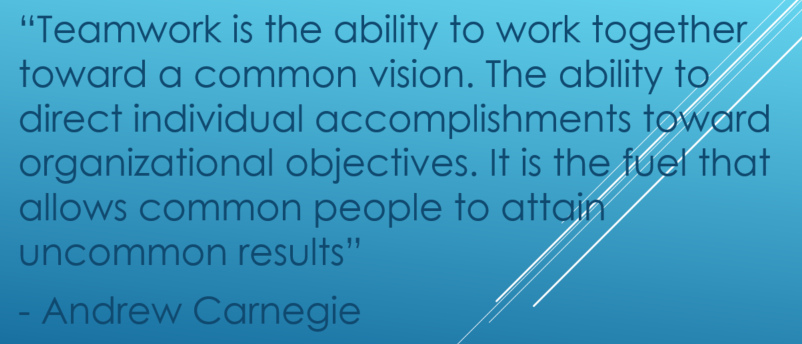
If you are an FTO coordinator or are responsible in any way for assigning trainers to your Field Training Units you should be well versed in team building and forming. A training program is a group of people, with a common purpose, a mix of skills, a strong commitment to achieving a goal, and mutual accountability for achieving the desired goal. Sounds like a TEAM!!
So, what does it take to assemble and maintain an effective team? There are three steps to effective team building: 1) Set common goals 2) Purposefully select members 3) Build skills according to the goal.
- Set Common Goals- It is essential that clarity of purpose is realized and defined in concrete and measurable objectives. Members of the team must know how their contribution impacts the overall goal of the organization. Use SMART (Specific, Measurable, Achievable, Relevant, Time-based) goals to guide actions. As a coordinator, it is essential that you consistently remind trainers how they impact the organization in order to keep them informed, motivated, and focused. This communication needs to include an understanding of Standard Evaluation Guidelines, trainee expectations, and department culture.
- Purposefully Select Members- Members of the team should be carefully selected. Ask yourself when choosing a member of the team: Do they exhibit leadership traits? Do they have a shared sense of responsibility that will increase team morale and performance? Do they exhibit interpersonal relationship traits such as trust, respect, honesty, and acceptance? Do they increase experience, ability, and diversity on the team? Ultimately the selection of our trainers can be difficult but overall commitment to a team culture will improve communication and consistency in our programs.
- Build Skills According to the Goal- As a coordinator or team leader you should be seeking out team development opportunities. These can be individual team talents to improve individual experience and talent on the team however, the goal should be a team-oriented approach. Often we seek out training opportunities based on individual wants or skill preferences. A team leader seeks to build the team over any individual team member. Look for ways to take courses or training together as a team, encourage sharing knowledge across the team, and seek opportunities that are focused on the team goal of training new employees such as leadership courses, adult learning, and training concepts.
Sabina Nawaz in her article How to Create Executive Team Norms- and Make Them Stick, published in the Harvard Business Review describes Team norms as “a set of agreements about how members will work with each other and how the group will work overall. These agreed-upon behaviors allow them to increase its collective performance through healthy debate and clarity of purpose”. One of the challenges in our training programs is consistency. Consistency across training standards, evaluations, expectations, and communication is challenging building a team culture can address these challenges and improve morale, communications, and effectiveness.
Source: Nawaz, Sabina. (2018). How to create executive team norms—and make them stick. Harvard Business Review. Retrieved May 10, 2019, from https://hbr.org/2018/01/how-to-create-executive-team-norms-and-make-them-stick
Bittle, Mark. (2022) Collective Impact: The Role of Teams and Teamwork. Johns Hopkins




Leave a Reply
You must be logged in to post a comment.